Enhancing Robot Social Navigation
with Reinforcement Learning
and Advanced Predictive Models
Student: Goodluck Oguzie
190212683@aston.ac.uk
Supervisor: Dr. Luis J. Manso
Associate-Supervisor: Prof. Dr. Aniko Ekart
🔎 Presentation Outline
- Context, Motivation & Problem
- Reinforcement Learning Basics
- Predictive Models Overview
- Environments
- Key Contributions:
- Predictive World Models
- Cosine-Gated LSTM (CGLSTM)
- Adaptive Prediction Horizons
- Conclusion & Future Work
🤖 What is Social Robot Navigation?
💡 Definition:
Robots navigating among humans while respecting social norms, ensuring safety, and operating efficiently.
✔️ Importance:
Social robot navigation is crucial for seamless integration into environments such as healthcare, hospitality, and public spaces. Advanced predictive decision-making is essential to manage inherent unpredictability.
| Approach | ✅ Strength | ⚠️ Weakness |
|---|---|---|
| Rule Base (Arkin, 1998) | Simple & efficient | Fails in dynamic settings |
| Social Force Models (Helbing & Molnar, 1995) | Good for crowd modeling | Limited adaptability |
| RVO2 (Van den Berg et al., 2011) | Real-time collision avoidance; effective in dynamic scenarios | Limited in long-term planning and human comfort prediction |
| Reinforcement Learning (Mnih et al., 2015) | Learns dynamically | Requires extensive training |
💡 Our Research: Integrates reinforcement learning with advanced predictive models to overcome these limitations.
🚀 The Problem:
"Robots struggle to navigate in social environments due to unpredictable human behavior."
Predict vs. React
🔍 Research Questions
❓ Q1: How do predictive world models improve decision-making in Social Robot Navigation (SocNav)?
❓ Q2: What challenges arise when transitioning Reinforcement Learning applications from discrete to continuous action spaces in Social Robot Navigation, and how can we address the challenges?
RL Fundamentals
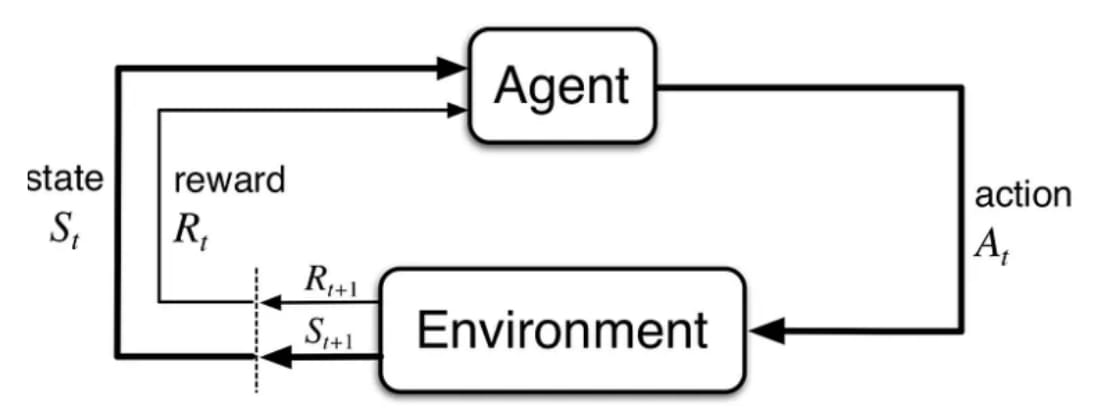
🔍 Reinforcement Learning (RL) is a method by which an agent learns to make optimal decisions by taking actions in an environment to maximize cumulative reward (Sutton & Barto, 2018).
| RL Algorithm | 🎯 Strengths | ⚠️ Limitations |
|---|---|---|
| DQN (Mnih et al., 2015) | Efficient in discrete tasks | Not suited for continuous or complex action spaces |
| DDPG (Lillicrap et al., 2015) | Effective in continuous control tasks | Sensitive to hyperparameters and exploration noise |
| PPO (Schulman et al., 2017) | Stable learning; good sample efficiency | Sensitive to hyperparameter tuning |
| TD3 (Fujimoto et al., 2018) | Addresses overestimation bias in DDPG | Still requires careful hyperparameter tuning |
| SAC (Haarnoja et al., 2018) | Robust for continuous control; promotes exploration | Higher computational demands |
| DreamerV3 (Hafner et al., 2023) | Learns a latent world model for planning | Sensitive to model inaccuracies and observation noise |
Predictive Models
🤝 Predictive Models are machine learning models that learn from sequential data to forecast future states.
| Model | Description | 🎯 Pros | ⚠️ Cons |
|---|---|---|---|
|
RNN (Rumelhart et al., 1986) |
Basic recurrent net passing hidden states across time | 🎯 Simple, good for short sequences | ⚠️ Vanishing/exploding gradients for long sequences |
|
LSTM (Hochreiter & Schmidhuber, 1997) |
Adds gating (input, forget, output) for long-term dependencies | 🎯 Mitigates vanishing gradients; better for lengthy sequences | ⚠️ More parameters, heavier computation |
|
GRU (Cho et al., 2014) |
A simplified LSTM with fewer gates | 🎯 Fewer parameters, faster training than LSTM | ⚠️ May capture slightly less nuance for very long sequences |
|
Transformers (Vaswani et al., 2017) |
Employ self-attention for global context | 🎯 Excels at capturing long-range dependencies | ⚠️ High memory & compute requirements |
World Models (Ha & Schmidhuber, 2018)
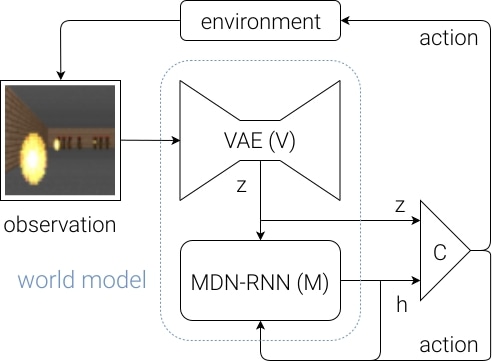
Dreamer: A Step Forward, but Still Not Adaptive Enough
- ✅ Builds on World Models
- ⚠️ Does not consider all the possible actions
- ⚠️ Fixed Prediction Horizon (one step ahead)
- ⏱ Limited Real-Time Prediction Horizon Adaptation
Environments Used
⚗️ FallingBallEnv
📌 Purpose: Toy environment for sequence prediction.
🪂 LunarLander‑v2
📌 Purpose: A Simple Continuous control task for RL.
🏙 SocNavGym
📌 Purpose: Benchmark for social navigation tasks.
🏷 LiteSocNavGym
📌 Purpose: Lightweight variant for quicker iteration.
Predictive World Models for Social Navigation (Contribution 1)
- The goal is to mitigate limitations of World Models:
- 🔎 single-step prediction
- 📌 limited actions
- 🎯 enabling multi-step, adaptive decision-making in dynamic social environments.
Paper PDF / Extended Explanation
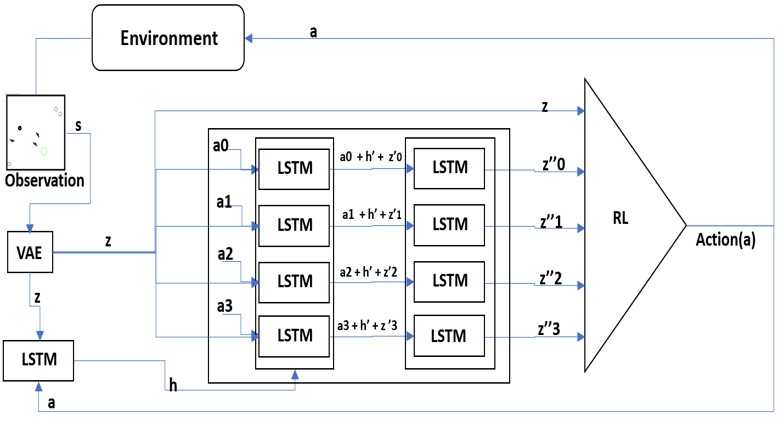
🧩 2StepAhead Predictive World Model
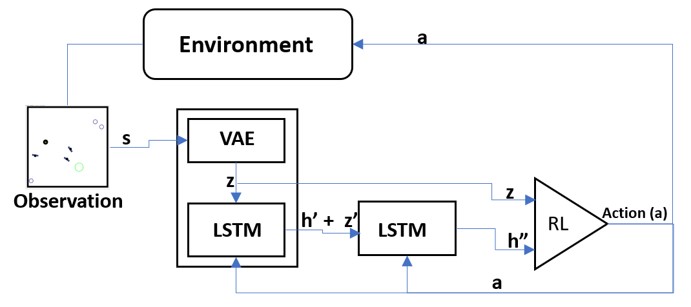
🎛 Multi Action State Predictive Model (MASPM)
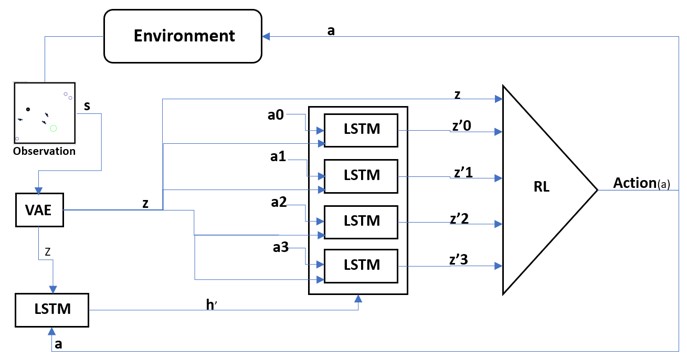
🔗 2StepAhead-MASPM (Hybrid Model)
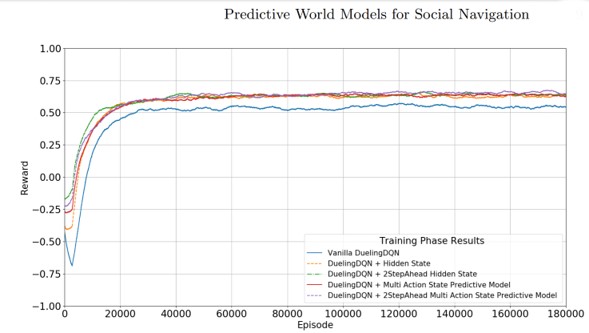
⏱ Training Metrics
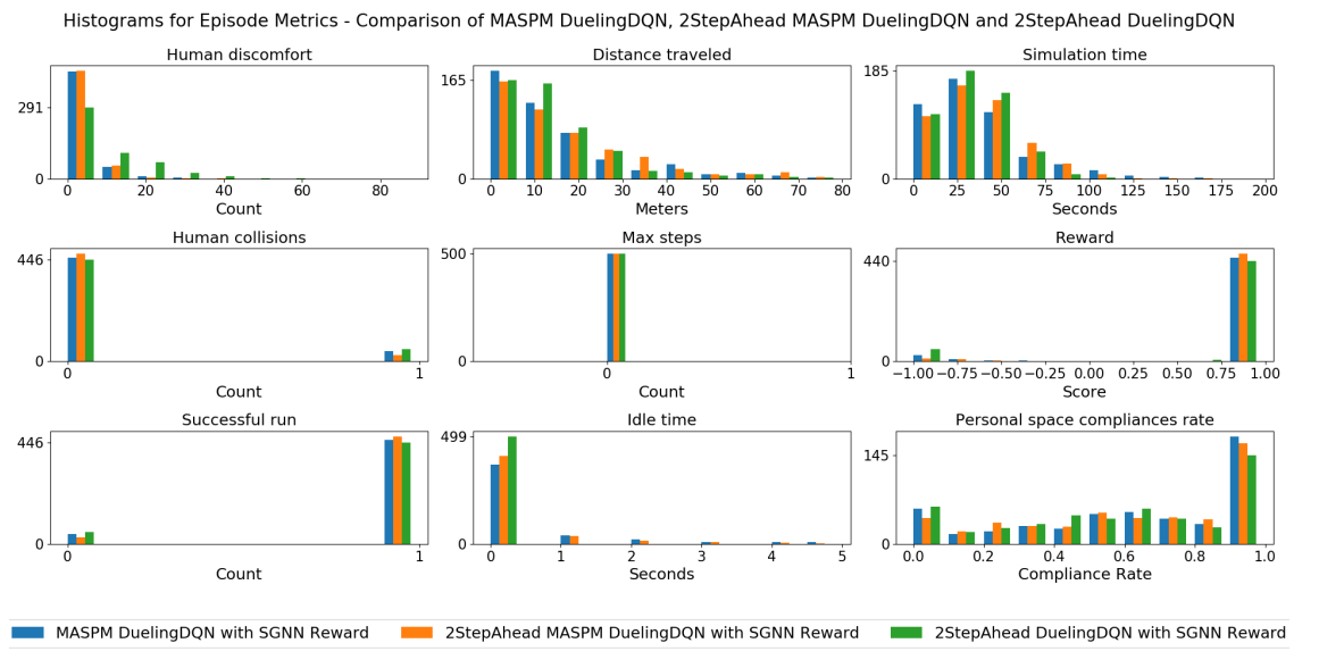
🎯 Testing Metrics (1)
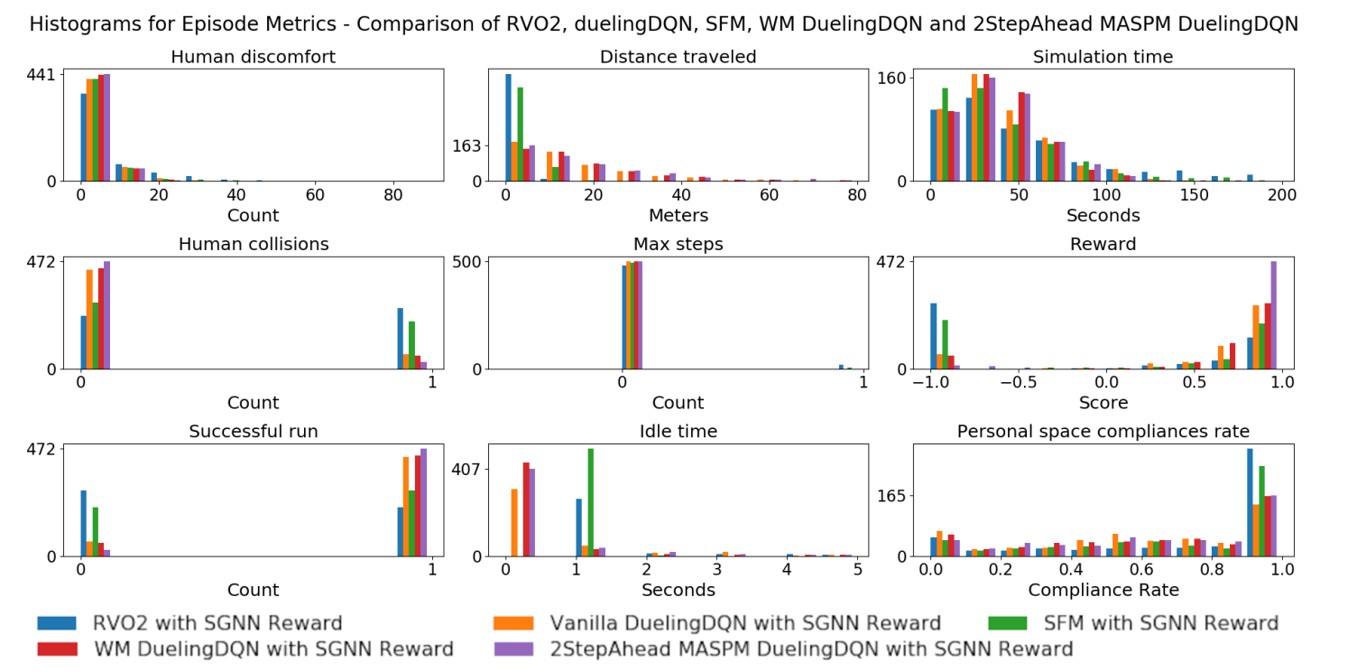
🎯 Testing Metrics (2)
Cosine-Gated LSTM (CGLSTM)
Contribution 2:
- 🤖 Aims to improve sequence prediction by focusing on directional alignment.
- 📌 Builds on limitations observed in previous LSTM experiments (e.g., in SocNavGym).
Paper PDF / Extended Explanation
🔍Limitations
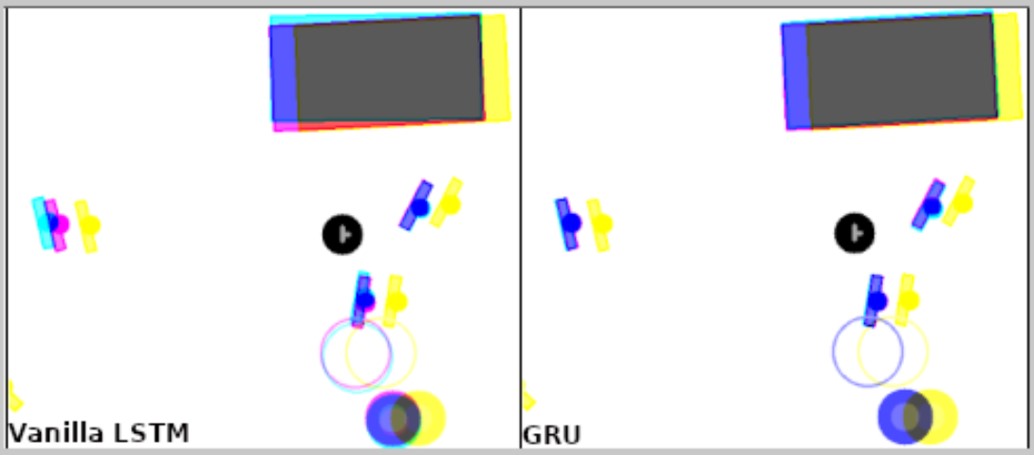
📌 They struggle with dynamic environments when predicting further ahead.
💡 Why Cosine-Gated LSTM?
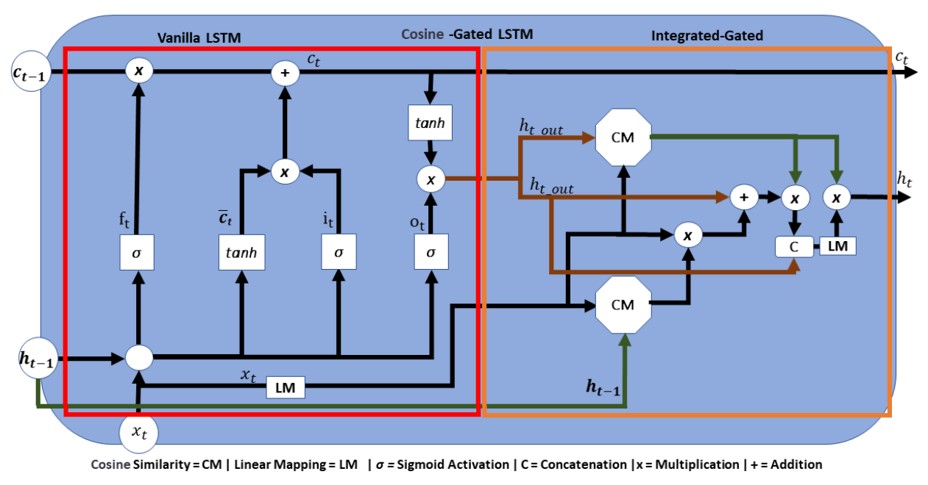
- 🤖 Emphasizes directional alignment in sequence prediction.
- 📌 Addresses the limitations of vanilla LSTM in handling long term prediction .
🏗️ CGLSTM Architecture
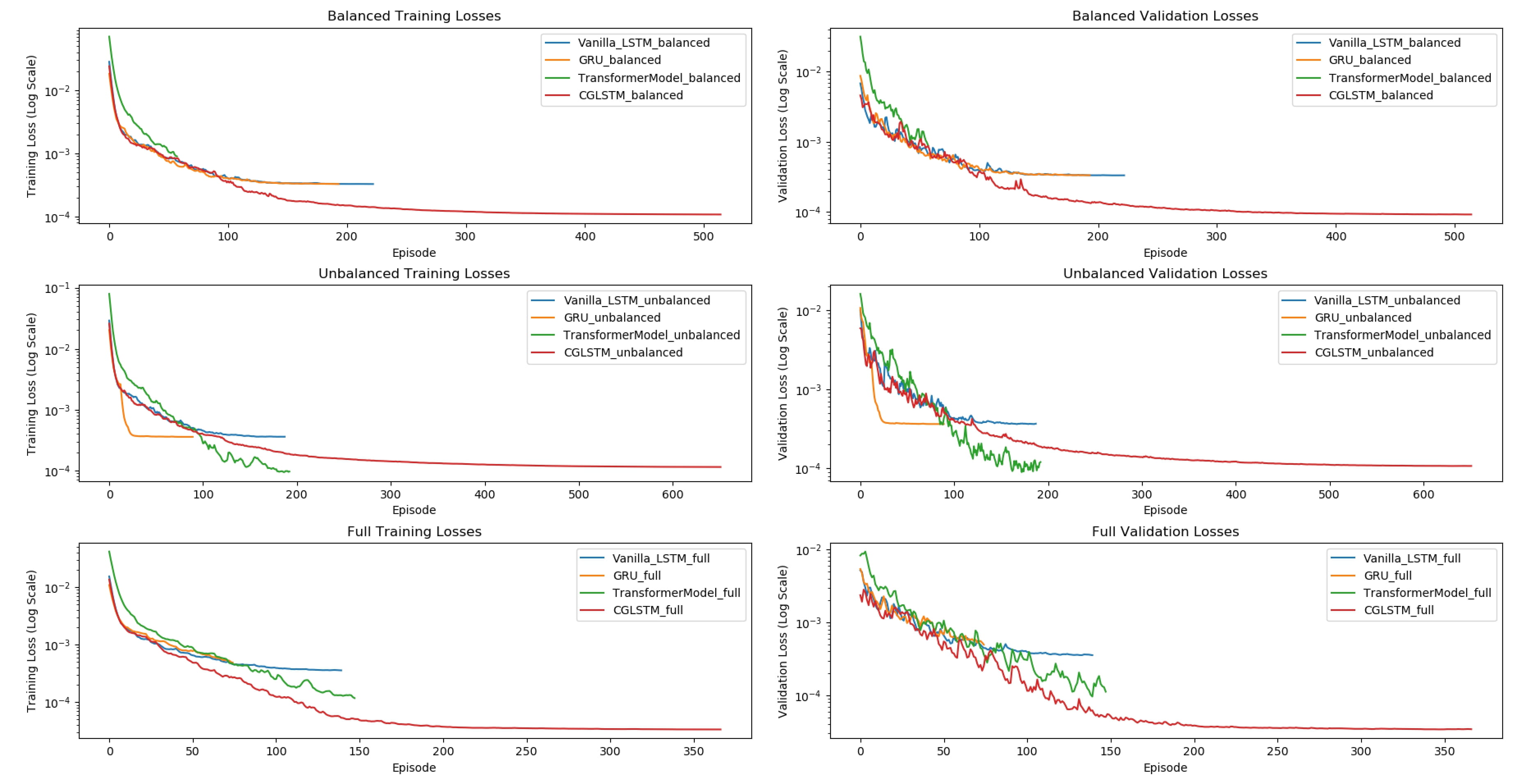
⏱ FallingBallEnv Results
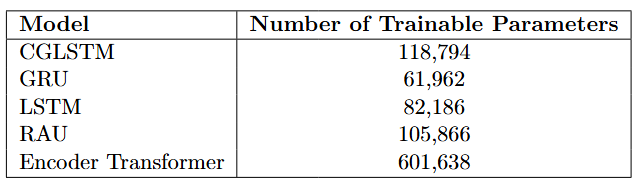
📊 Model Parameter Count
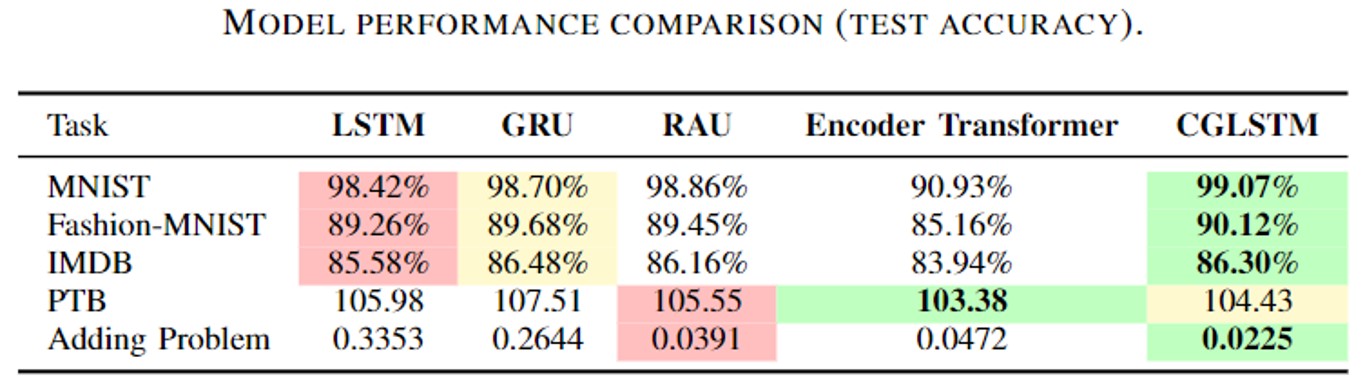
🎯 Benchmark Tasks (MNIST, etc.)
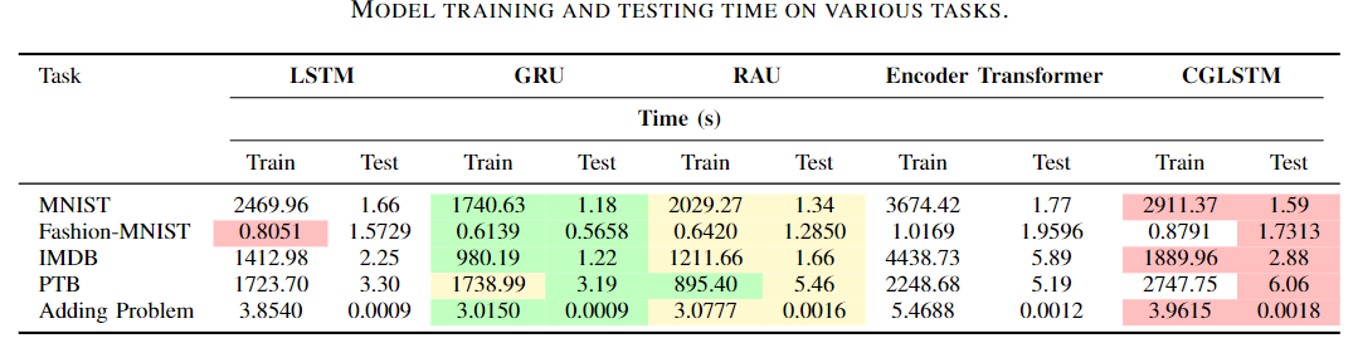
⏲️ Training & Testing Times
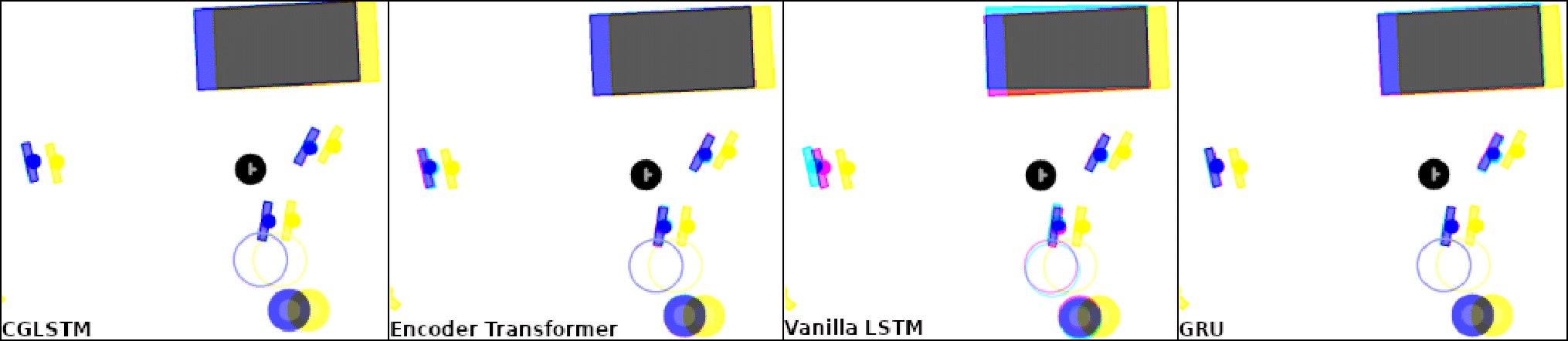
🤖 SocNavGym: Realistic Scenario

🎯 Multi-Model Prediction Comparison
Entropy‐Driven Adaptive Prediction Horizons
Contribution 3:
- ✅ Propose an entropy-driven adaptive Prediction horizon within SAC.
- 🤖 Integrate CGLSTM into DreamerV3 for enhanced predictive modeling.
- 📊 Benchmark vs. SAC, PPO, TD3, DDPG, DreamerV3 variants.
🔑 Proposed Methods
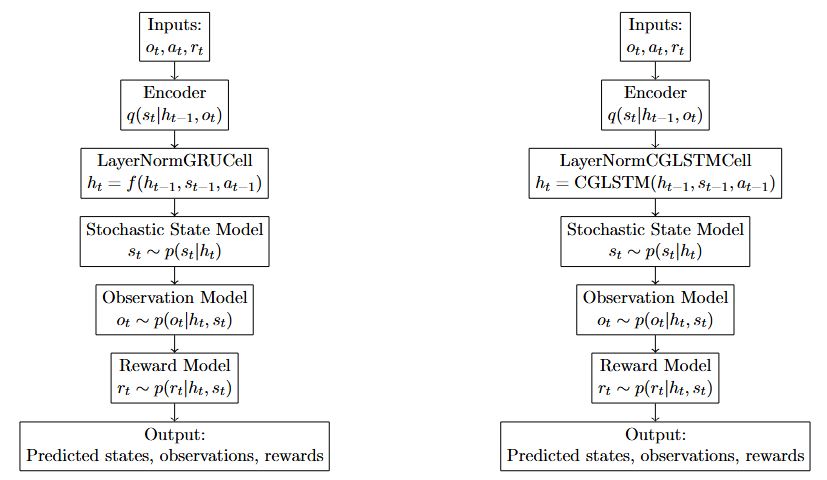
- 🚀 DreamerV3 + CGLSTM
- 🔗 2StepAhead-MASPM (Fixed Horizon)
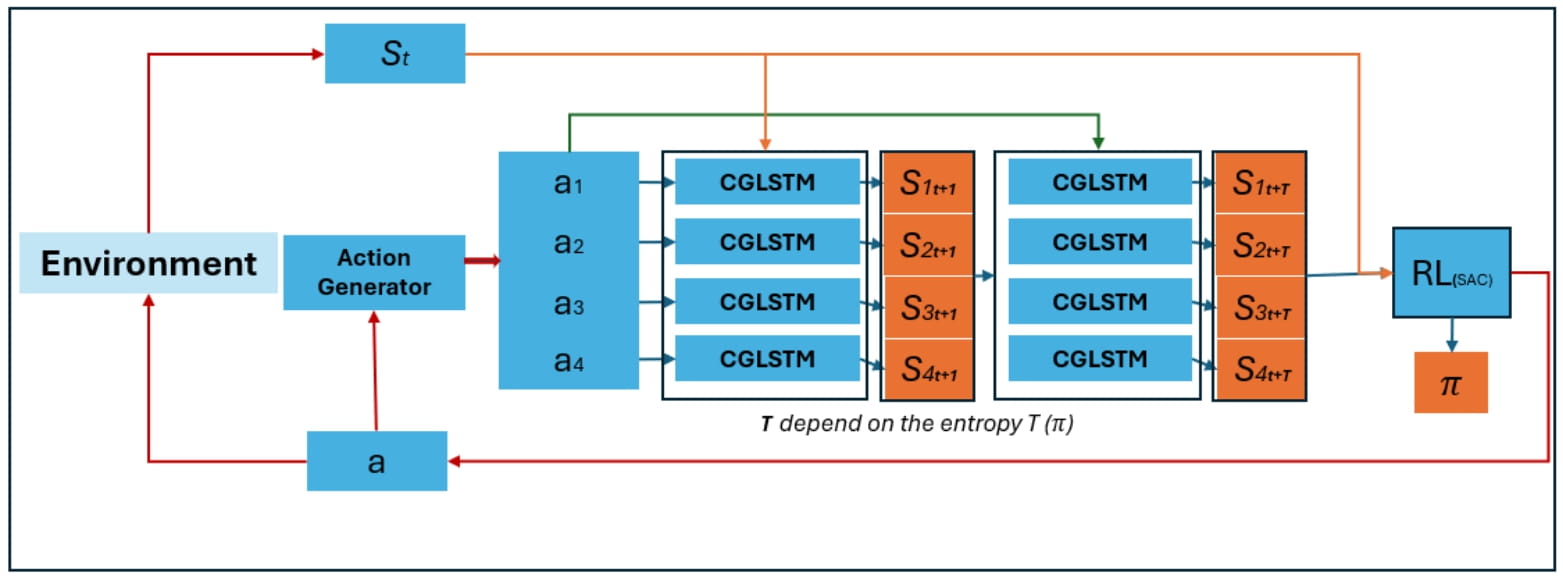
- 🤖 SAC + CGLSTM (Adaptive Prediction Horizon)
🚀 Proposed: DreamerV3 + CGLSTM
🔗 Proposed: 2StepAhead-MASPM (Fixed Horizon)
🤖 Proposed: SAC + CGLSTM (Adaptive Prediction Horizon)
🧪 Preliminary Experiments Overview
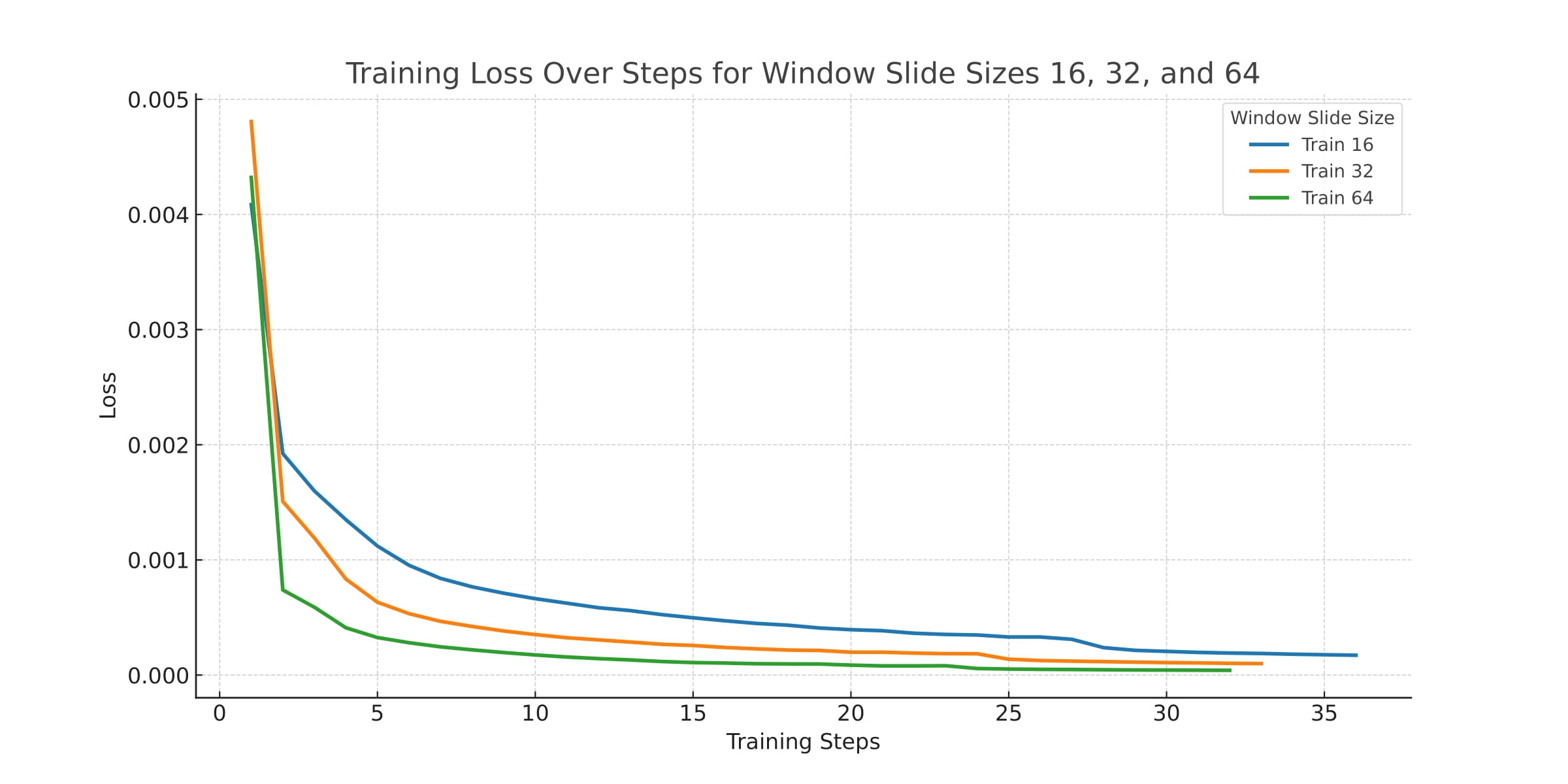
- ⚙️ Tested window-slide sizes: 16, 32, 64 for trade-offs in cost vs. accuracy.
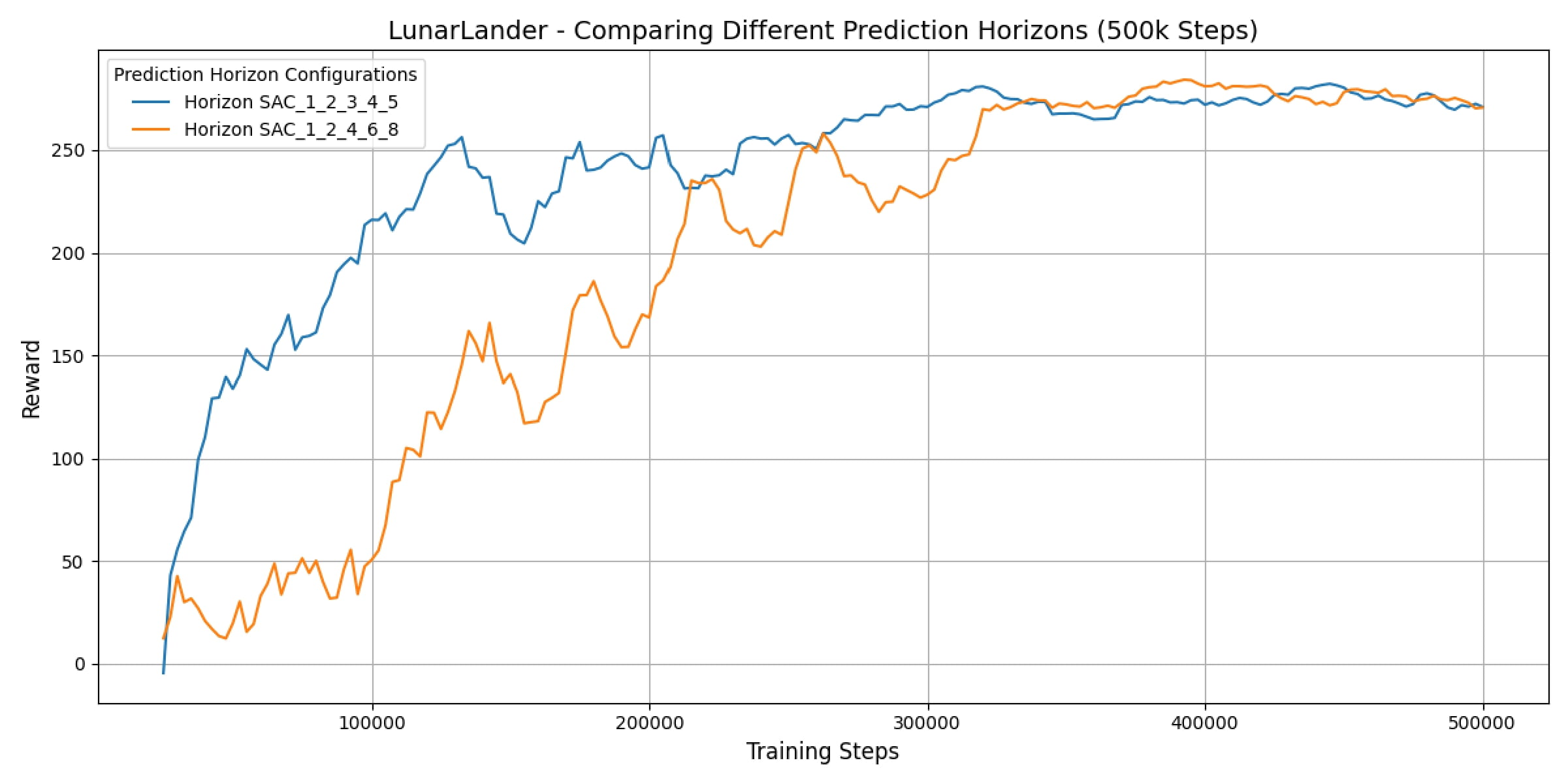
- 🎯 Compared horizon sets {1,2,3,4,5} vs. {1,2,4,6,8} vs. fixed 8-step horizon.
📊 Window-Slide Selection
🎯 Adaptive Prediction Horizon Selection
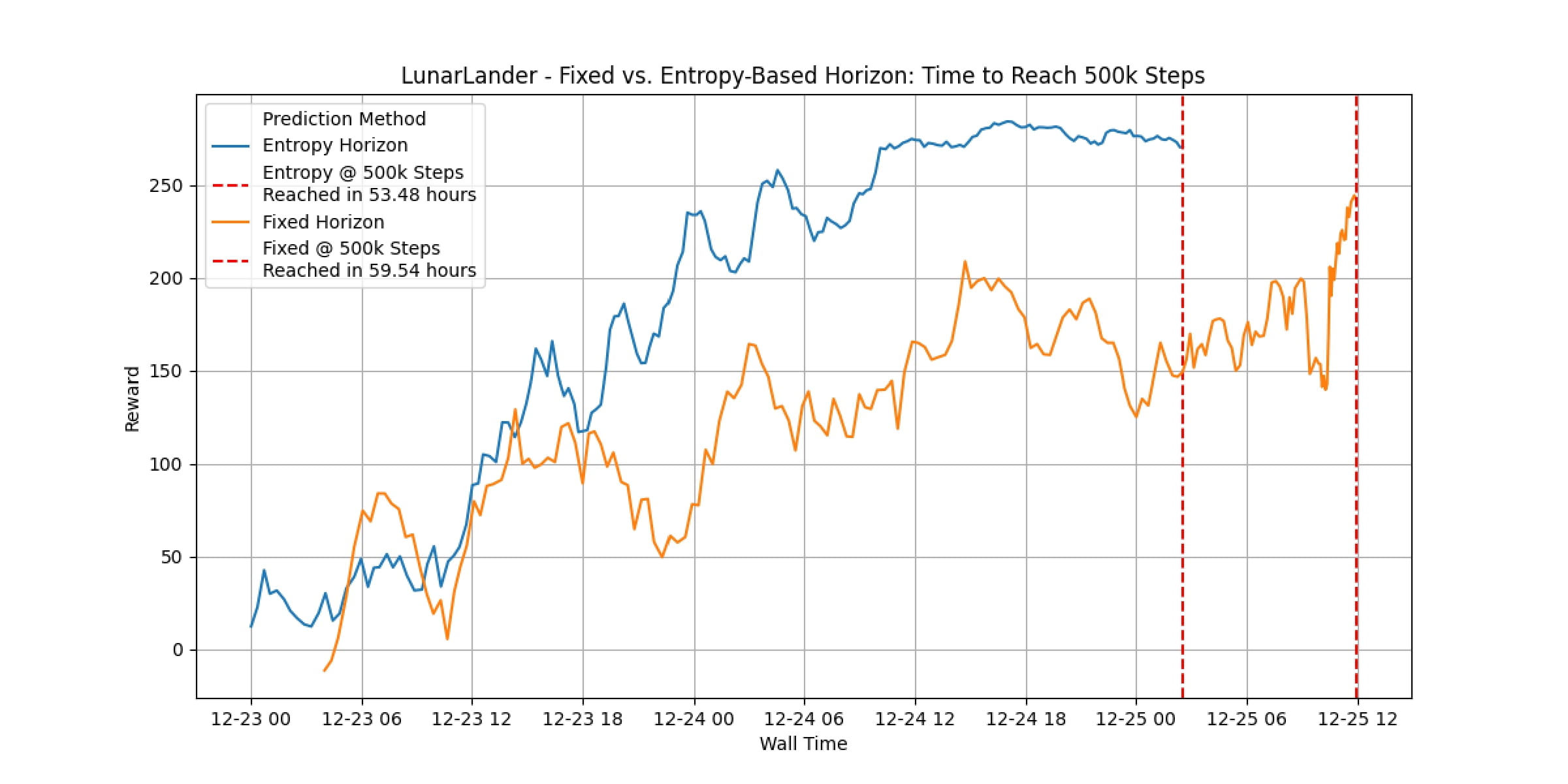
📊 Adaptive vs. Fixed Horizon
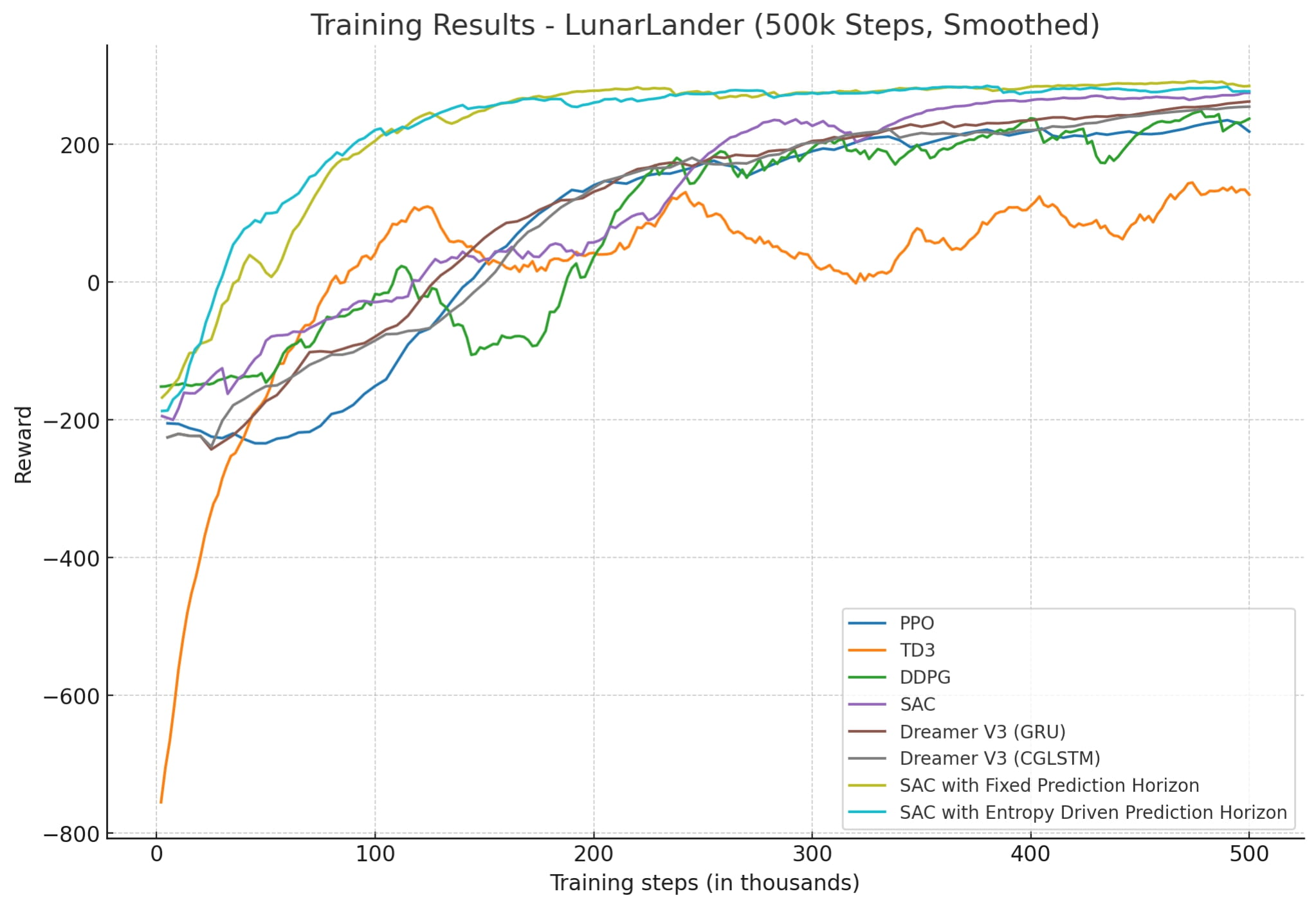
⏱ Training Results: LunarLander
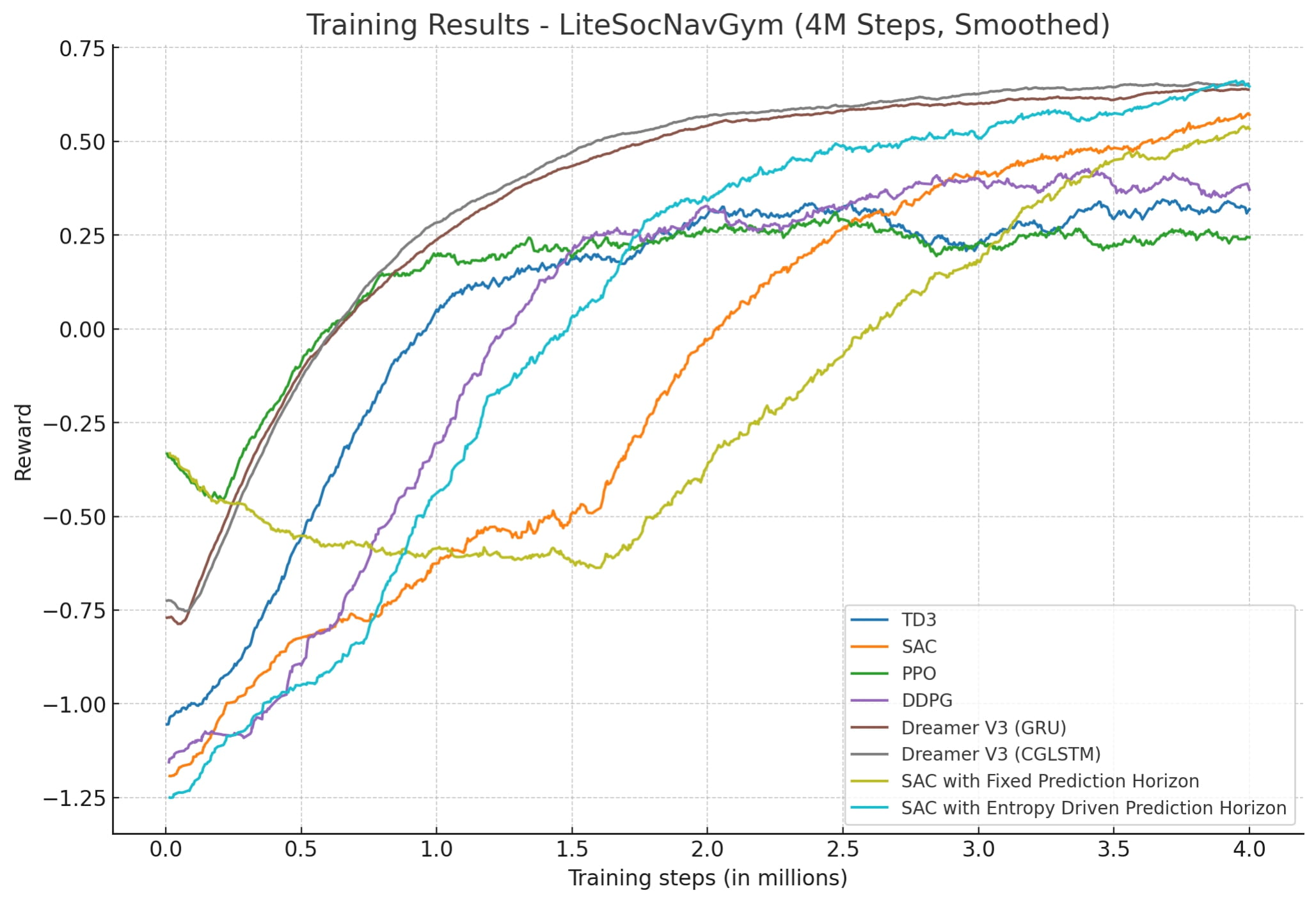
⏱ Training Results: LiteSocNavGym
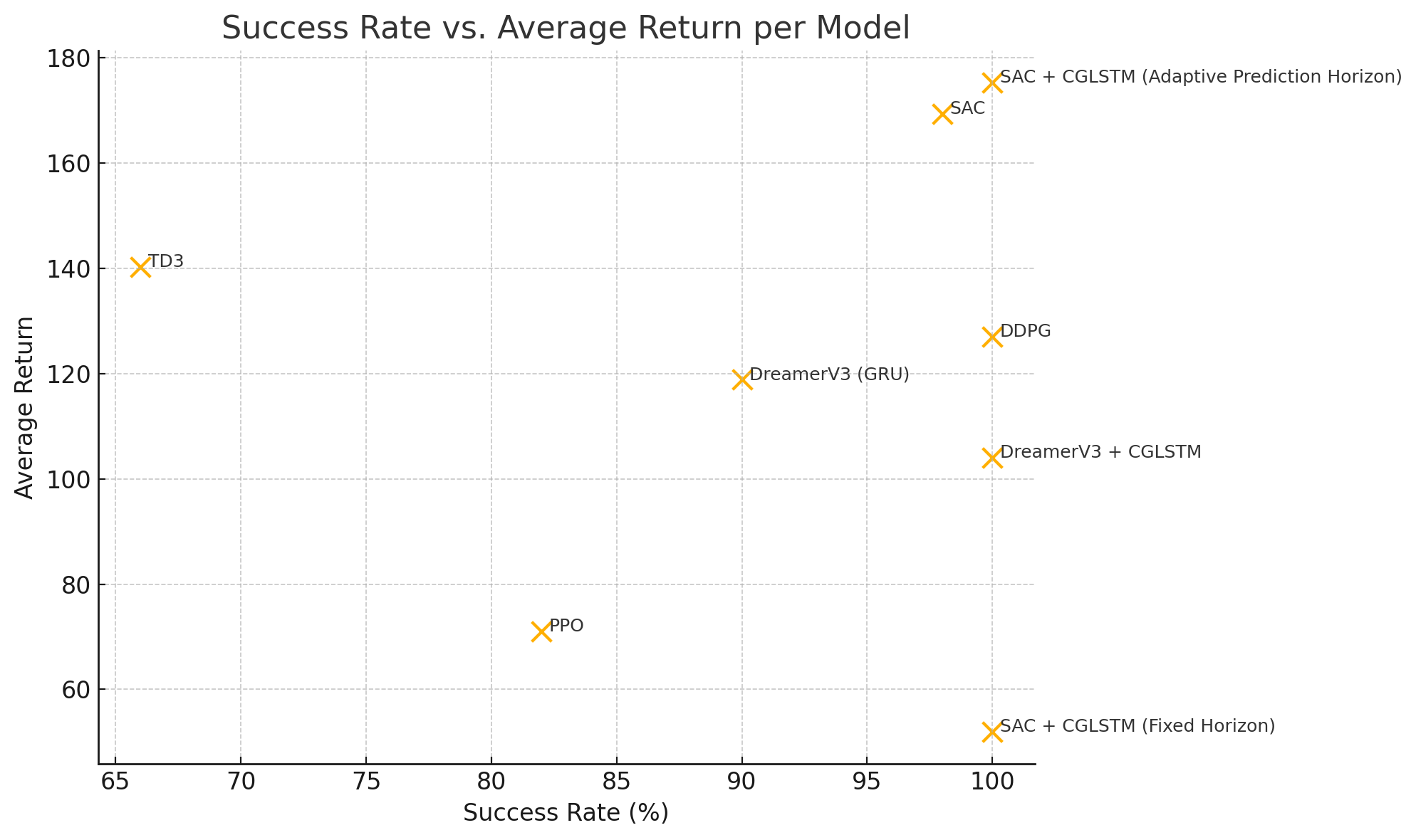
📊 LunarLander Results (1)
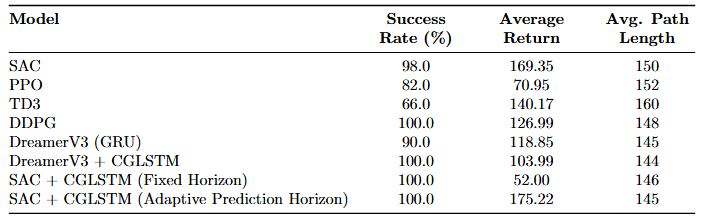
📊 LunarLander Results (2)
Note: Gaussian noise (σ = 0.085) added during testing.
📊 LunarLander Results (3)
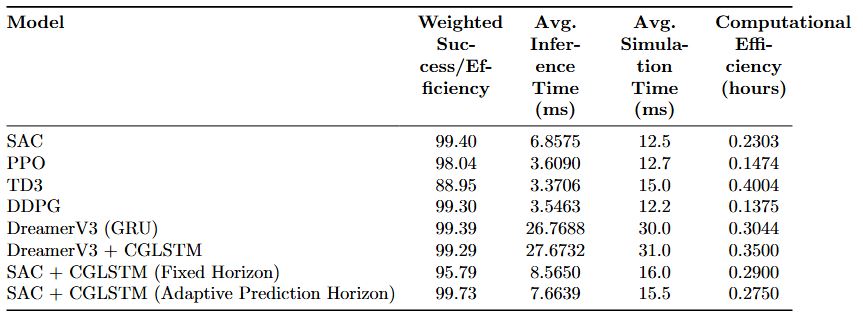
📊 LiteSocNavGym Results (3)
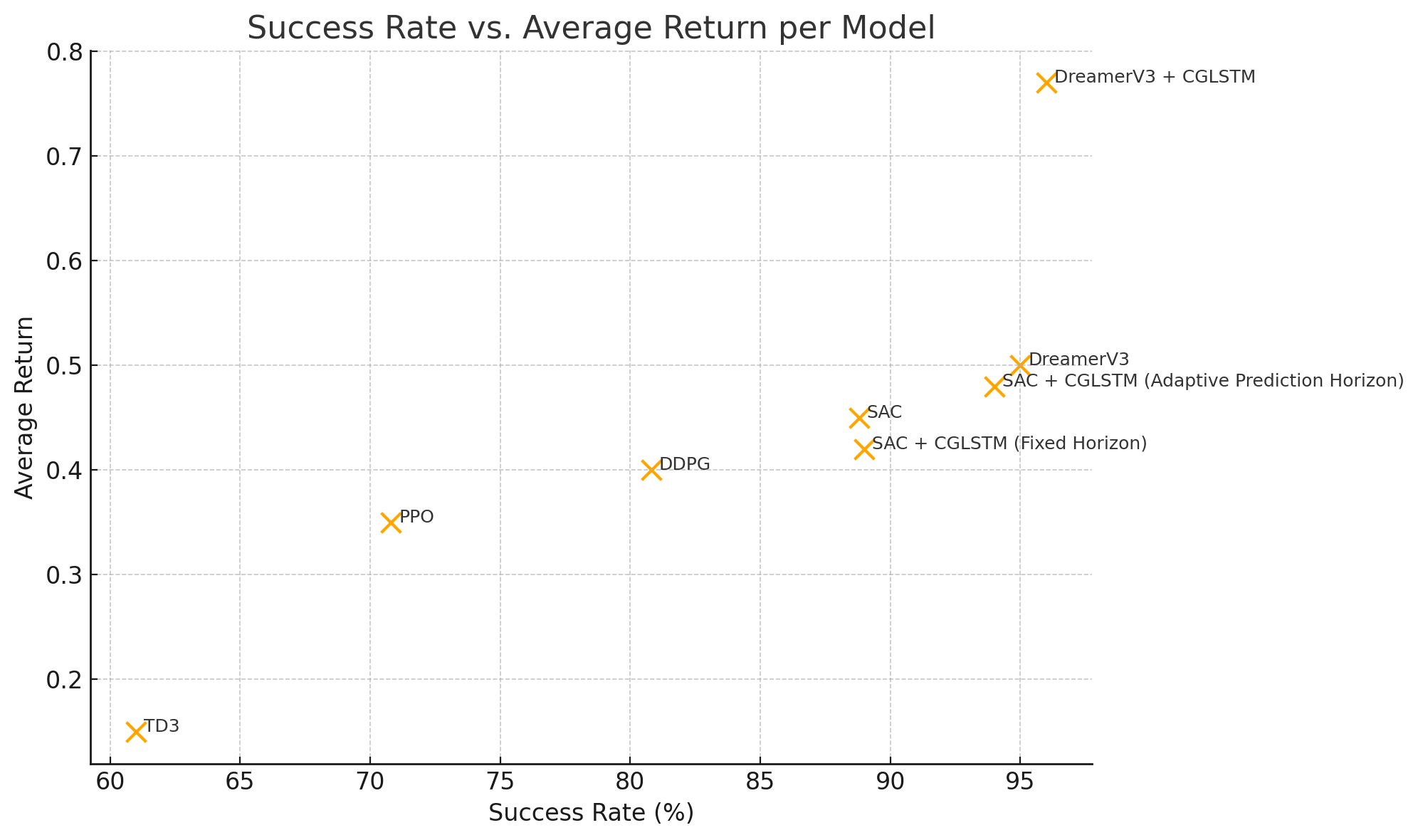
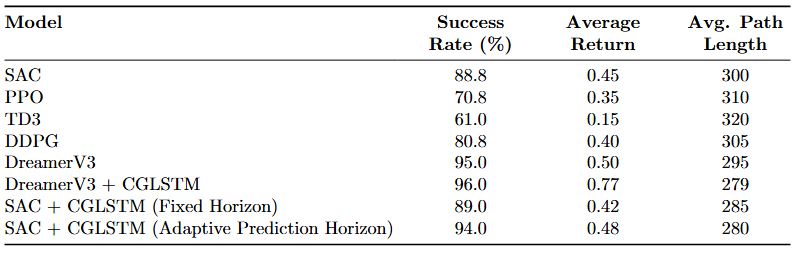
📊 LiteSocNavGym Results (1)
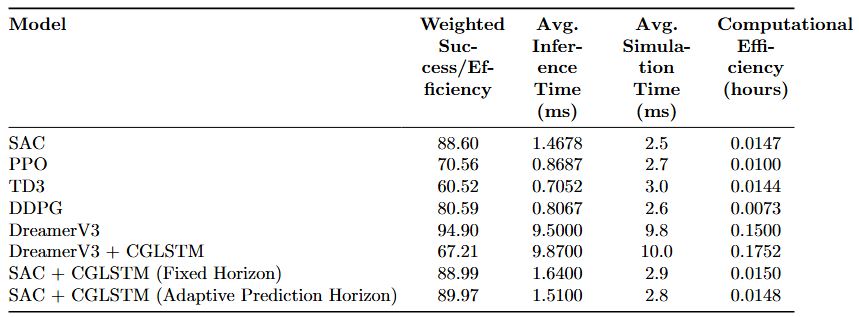
📊 LiteSocNavGym Results (2)
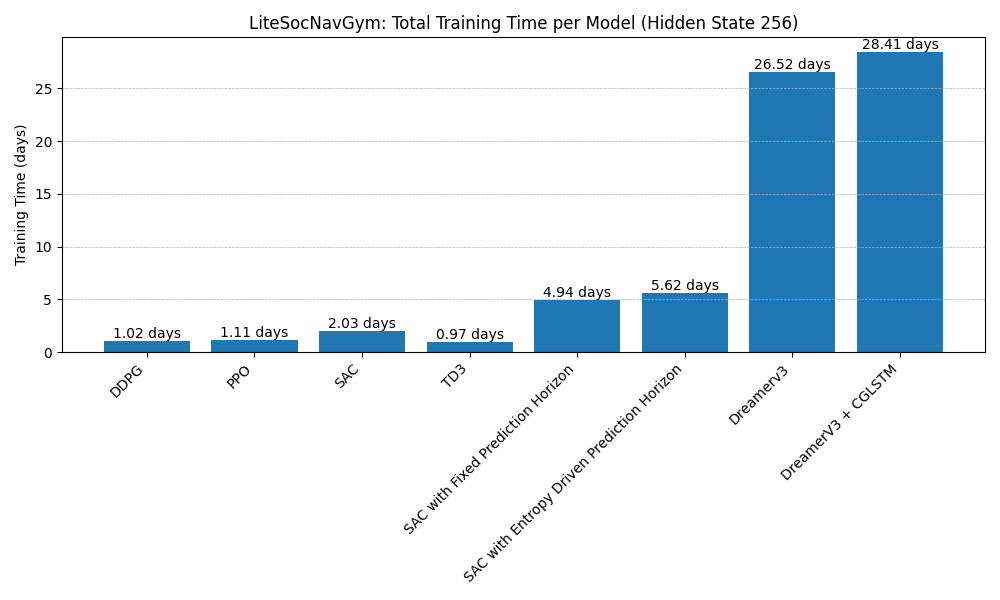
⏱ Training Time per Model
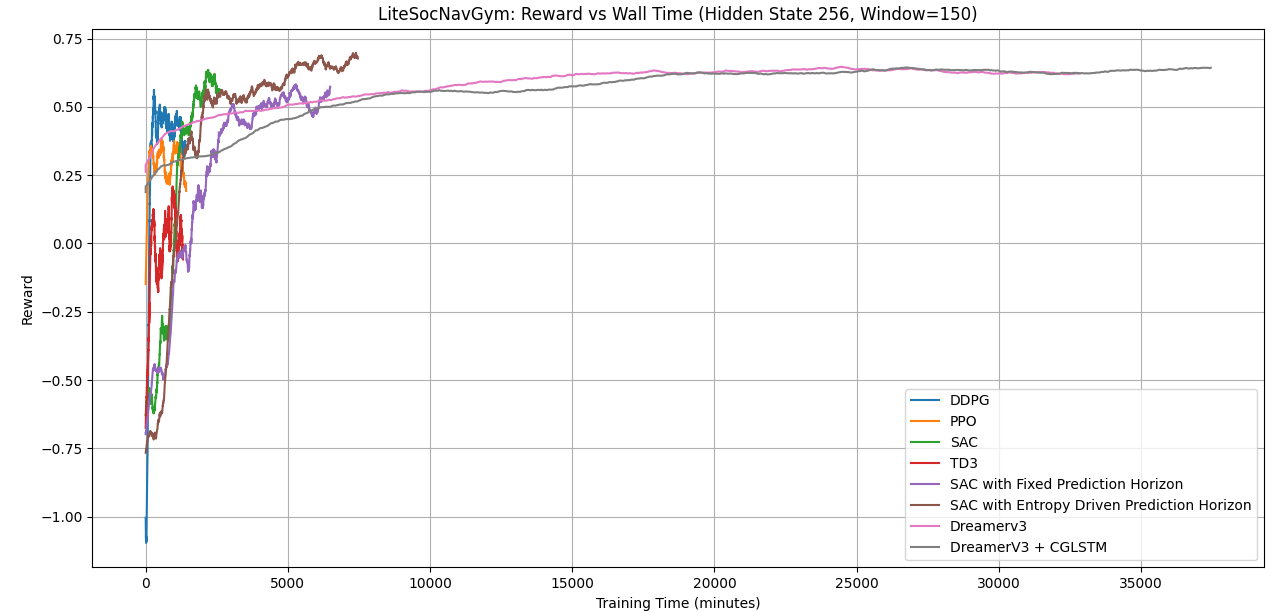
📈 Reward vs. Wall Clock
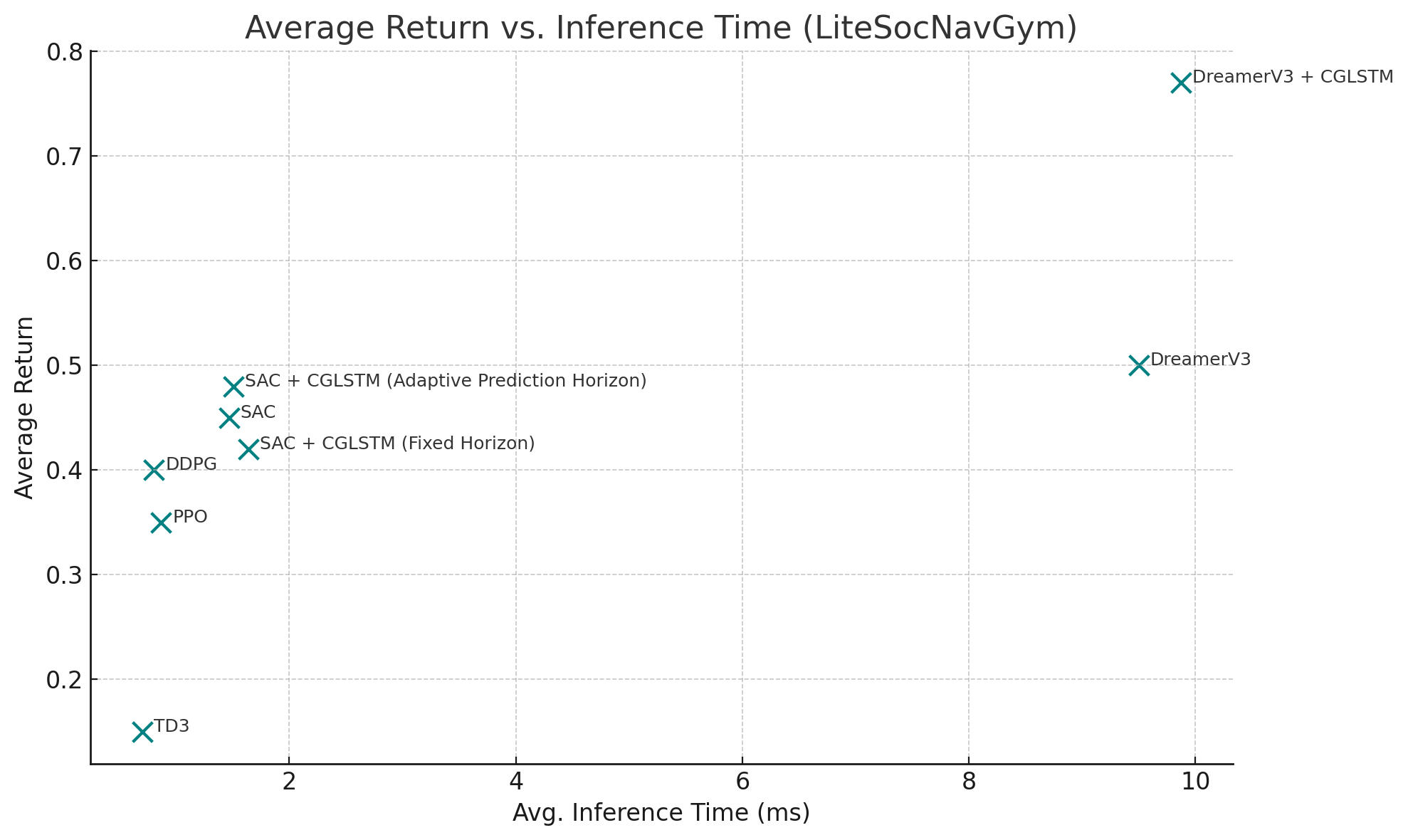
⚙️ Inference Time vs. Return
🎉 Conclusion
- 🔍 Novel Predictive Models: 2StepAhead, MASPM, and CGLSTM address short-horizon and reactive limitations in social robot navigation.
- ✅ Enhanced Performance: Demonstrated higher safety, human comfort, and success rates in diverse simulation environments.
- 🚀 Adaptive Horizons in RL: Introduced an entropy‐driven approach that surpasses fixed-horizon methods and enhances continuous-control capabilities.
🚀 Future Work
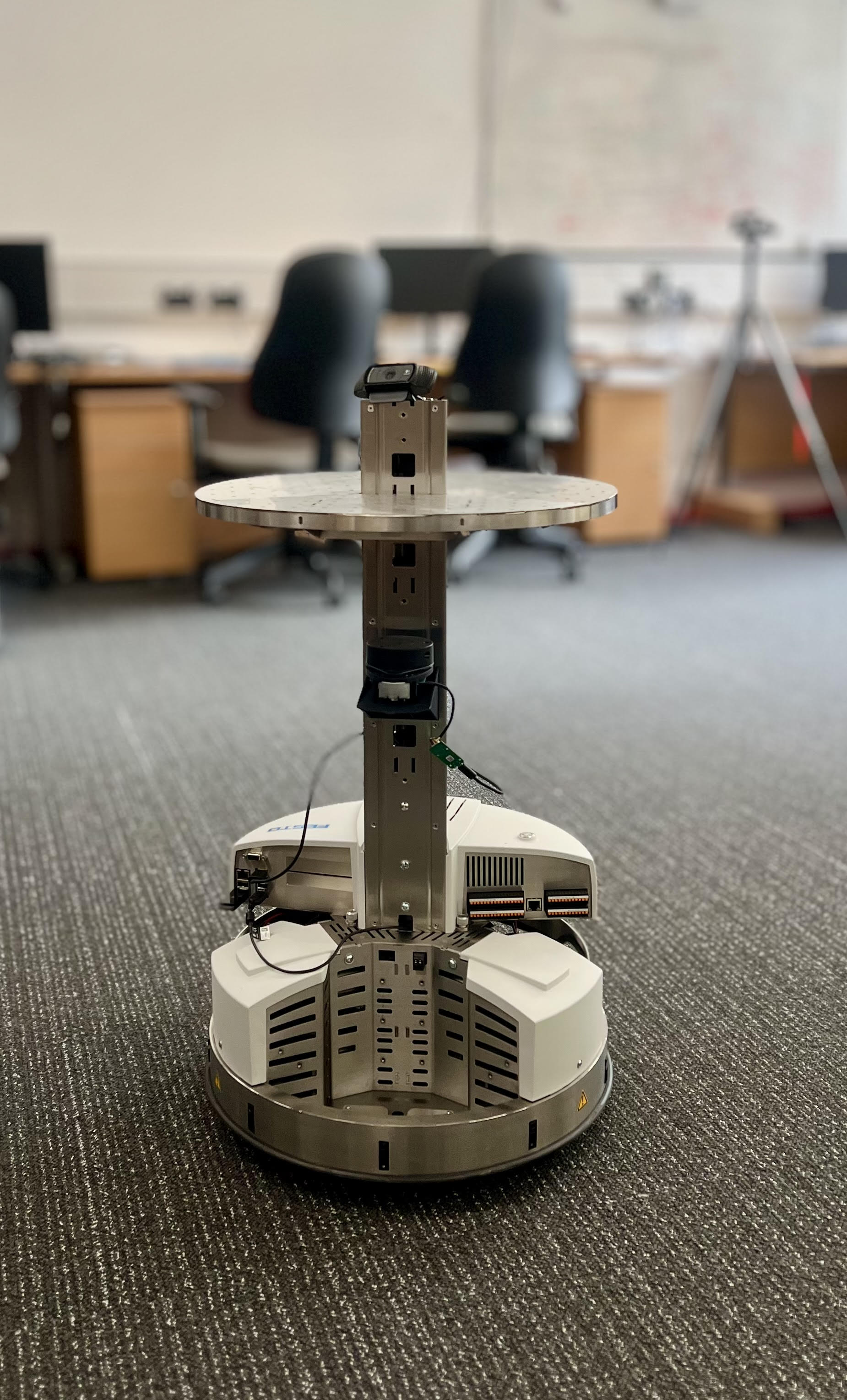
Deploy RL models on a real robot.
Publications Arising from this Thesis
- 🎯 Oguzie, Goodluck, e Anikó Ekárt (2023). "Predictive World Models for Social Navigation." In: Advances in Computational Intelligence Systems, Contributi Presentati al 22° UK Workshop on Computational Intelligence (UKCI). Advances in Intelligent Systems and Computing (AISC). Springer. (In stampa)
- 🔍 Oguzie, Goodluck. "Cosine-Gated LSTM." In: 2024 IEEE 5ª Conferenza Internazionale su Pattern Recognition e Machine Learning (PRML), pp. 8–15. IEEE, 2024.
- 🚀 Oguzie, Goodluck. "Adaptive Prediction Horizons in RL." (In Progress).
📚 References (1–8)
- R. C. Arkin, Behavior-Based Robotics. MIT Press, 1998.
- D. Helbing and P. Molnar, “Social force model for pedestrian dynamics,” Phys. Rev. E, vol. 51, no. 5, p. 4282, 1995.
- J. van den Berg, S. J. Guy, M. Lin, and D. Manocha, “Reciprocal n-body collision avoidance,” in Robotics Research. Springer, 2011.
- V. Mnih, K. Kavukcuoglu, D. Silver, et al., “Playing Atari with deep reinforcement learning,” arXiv preprint arXiv:1312.5602, 2013.
- R. S. Sutton and A. G. Barto, Reinforcement Learning: An Introduction, 2nd ed. MIT Press, 2018.
- T. P. Lillicrap, J. Hunt, A. Pritzel, et al., “Continuous control with deep reinforcement learning,” arXiv preprint arXiv:1509.02971, 2015.
- J. Schulman, F. Wolski, P. Dhariwal, et al., “Proximal policy optimization algorithms,” arXiv preprint arXiv:1707.06347, 2017.
- S. Fujimoto, H. van Hoof, and D. Meger, “Addressing function approximation error in actor-critic methods,” in Proc. 35th Int. Conf. Machine Learning (ICML), 2018.
📚 References (9–15)
- T. Haarnoja, A. Zhou, K. Hartikainen, et al., “Soft actor-critic algorithms and applications,” arXiv preprint arXiv:1812.05905, 2018.
- D. Hafner, T. Lillicrap, M. Norouzi, and J. Ba, “Mastering diverse domains through world models,” arXiv preprint arXiv:2301.04104, 2023.
- D. E. Rumelhart, G. E. Hinton, and R. J. Williams, “Learning representations by back-propagating errors,” Nature, vol. 323, pp. 533–536, 1986.
- S. Hochreiter and J. Schmidhuber, “Long short-term memory,” Neural Computation, vol. 9, no. 8, pp. 1735–1780, 1997.
- K. Cho, B. van Merrienboer, D. Bahdanau, and Y. Bengio, “On the properties of neural machine translation: Encoder-decoder approaches,” arXiv preprint arXiv:1409.1259, 2014.
- A. Vaswani, N. Shazeer, N. Parmar, et al., “Attention is all you need,” in Advances in Neural Information Processing Systems (NIPS), 2017.
- D. Ha and J. Schmidhuber, “Recurrent world models facilitate policy evolution,” in Advances in Neural Information Processing Systems (NIPS), 2018.